Gastronomy Certificate
WHAT IS GASTRONOMY?
If we were to explain what gastronomy is, it is a discipline that examines the relationship between culture and food.
The word gastronomy was first used by the French writer Joseph Berchoux. Originating in 1801, gastronomy is a combination of the Greek words "Gastro," meaning stomach, and "Nomos," meaning law or rule. The field of gastronomy encompasses the entire process of preparing edible substances, from their preparation to consumption, in a way that is hygienic but not necessarily healthy, while aiming for maximum visual and culinary pleasure.
WHAT IS A GASTRONOMY TOURISM CERTIFICATE?
GASTRONOMY FACILITY
A. What is a gastronomy establishment? These are food and beverage establishments where culinary culture is transformed into a tourism product and presented to customers, offering regional, traditional, national, or international cuisine and food and beverage service. They are considered to contribute to national tourism and are therefore deemed eligible for support by the Ministry.
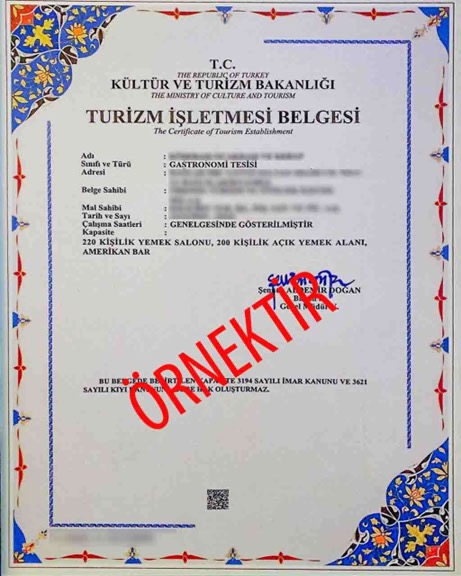
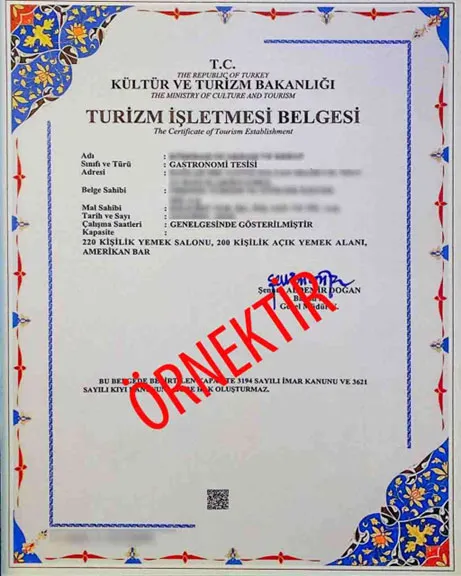
Example of a gastronomy certificate.
Gastronomy establishments possess the following qualities:
– At least one of the following qualifications must be met.
–The business must have brand recognition or reputation in local, regional, national, or international print and visual media in the food and beverage sector, excluding mass production and ready-made meals.
–The business has a right based on a franchise, operating agreement or similar contract which includes the right to use a business that meets the qualifications in subparagraph (1).
– The applicant is a natural person or, if the applicant is a legal entity, the controlling shareholder or another company in which the shareholders own more than fifty-one percent of the shares; having a separate business with the qualifications listed in subparagraph (1) or (2) other than the business for which the document is requested.
– The applicant, whether a natural person or a legal entity, or their controlling shareholder or partners holding a majority of shares, must possess a diploma or internationally recognized certificate in the field of gastronomy from a national or international formal education institution.
– (Addition: RG-4/4/2020-31089-C.K-2360/2 art.) The facility must be located in an area with intense tourism activity.
b) In addition to clause (a), in these facilities:
1) The restaurant must have an à la carte service and meet the specifications stated in subparagraph (f) of the fifth paragraph of Article 14, provided that the kitchen area is at least twenty-five square meters.
2) Businesses with open entrances must have a windbreak, air curtain, revolving door, or similar arrangement at the entrance.
3) The provision of separate toilets and washrooms for male and female customers.
4) The dining hall has an air conditioning system.
5) Furnishings, decorations, equipment, and service materials should be of superior quality or mass-produced, or specially designed and manufactured for the facility by an artist or local producer, or be custom-designed products; and if operating for cuisines of other nations, they should be of high quality and reflect the culture of that country, or incorporate elements of that culture.
6) The head chef must have a diploma from a national or international formal education institution in the field of gastronomy, or an internationally recognized certificate or award, or have local, national or international recognition; if the activity focuses on the cuisine of another nation, a head chef trained in that field must be employed.
7) At least twenty percent of the staff must have received training in their field.
8) The menu must include information on the ingredients, allergenic properties of the products, their suitability for vegetarian or vegan consumption, and whether they contain content sensitive to religious beliefs, all in at least two languages, one of which must be Turkish.
9) If national, regional, or traditional cuisine is served; at least five types of food ingredients must be selected from regional products, cooked using traditional methods or a modern interpretation of traditional methods, and presented, explained, and detailed in the menu.
10) In cases where the activity focuses on the cuisine of another nation, the food ingredients must be prepared and presented using products specific to that cuisine, either in traditional methods or by interpreting traditional methods with modern techniques, and this must be explained and described in the menu.
11) If the business focuses on world cuisine; at least three dishes each from appetizers, intermediate courses, main courses, and desserts must be prepared with high-quality ingredients and presented to the customer with appropriate serving materials, and these must be explained and described in the menu.
12) The food products offered must be prepared by the establishment and meet the required standards.
(3) Documents regarding the preservation of the qualifications in subparagraph (6) of paragraph (b) of the second paragraph are sent to the Ministry every six months.
(4) In establishments located in the immovable cultural heritage requiring protection, the metric measurements of the spaces specified in subparagraph (f) of the fifth paragraph of Article 14 and the service connection between the kitchen and the dining hall are evaluated according to the nature of the building.
HOW TO OBTAIN A GASTRONOMY CERTIFICATE?
Applications are submitted to the Ministry via the e-Government system by completing the application form and facility description form, along with the documents required in the Regulation and Circular. For gastronomy facility tourism business certificate applications, a video file of 5 to 7 minutes in length, including day and night footage of all areas of the facility and its menu, is submitted. For tourism business certificate applications, facilities whose applications are deemed suitable are included in the inspection program after an application review report is prepared.
WHO MAKES UP THE GASTRONOMY CERTIFICATE EVALUATION BOARD?
The Gastronomy Certificate Evaluation Board is chaired by the Deputy Minister of Culture and Tourism, to whom the General Directorate of Investments and Enterprises is subordinate, and consists of the General Director and Deputy General Director of Investments and Enterprises, the Chairman and Deputy Chairman of the Board of Controllers. It decides on requests for the issuance, cancellation, transfer, and addition of an operator's annotation regarding the main activity of tourism certificates for gastronomy establishments.
Following the evaluation board's decision, facilities whose gastronomy certificate applications are deemed suitable are certified. Applicants whose gastronomy certificate applications are deemed unsuitable will be informed in writing, stating the reasons. Facilities with identified deficiencies will be given a period of time to rectify them. If the deficiencies are found to be corrected by the end of this period, the facility will be certified. If the deficiencies are not corrected, the application will be rejected, and the applicant will be informed.
ADVANTAGES OF A GASTRONOMY CERTIFICATE
- With a gastronomy certificate, a license to sell alcoholic beverages openly can be obtained from TABDK (Turkish Alcohol and Tobacco Regulatory Authority).
- The trademark rights are protected by the Ministry of Culture and Tourism.
- Businesses holding a gastronomy certificate are only subject to inspection by the Ministry of Culture and Tourism.
- With a gastronomy certificate, the facility management can adjust operating hours according to the hours set by the Ministry of Culture and Tourism.
- It contributes to the reliability of the facility from the customer's perspective.
DOCUMENTS REQUIRED FOR A GASTRONOMY CERTIFICATE
- Business opening and operating license
- Signature circular, signature declaration,
- Turkish Republic identity number, or if it is a legal entity, trade registry and tax registry numbers,
- Trademark registration certificate,
- Required documents include a copy of the title deed, a lease agreement if the owner is a tenant, the owner's permission for the use of the property for the requested purpose (not required separately if stated in the lease agreement), and the owner's signature declaration or signature circular.
- If it is located within a cultural heritage site requiring protection, a copy of the registration decision or official document is required.
- Periods when the facility is open and closed
WHAT ARE THE REQUIREMENTS FOR A GASTRONOMY CERTIFICATE?
Gastronomy establishments are independent businesses.
- A restaurant located within an accommodation facility cannot apply to the Ministry of Culture and Tourism for a Gastronomy Facility Certificate.
- The food culture in restaurants should be presented to customers as a tourism product.
- All food items served in the restaurant must be prepared by the establishment.
- At least 20% of the staff working in the restaurant must have received training in this area.
- If a restaurant offers a cuisine with traditional, regional, national, or international characteristics, then the food and beverages should be served in accordance with these characteristics.
- The business must be separate from mass production and ready-made meals.
- The restaurant must have brand recognition or a reputation in local, regional, national, or international print and visual media in the food and beverage sector. The establishment must have at least one article or publication in visual or digital media that contains a positive review of its cuisine, menu, service quality, and similar features.
- If the business meeting the criteria is a franchise, it must have the necessary documentation to prove its rights.
- The head chef must possess diplomas or internationally recognized certificates in gastronomy obtained from international educational institutions.
- Businesses with open-air entrances should have windbreaks, air curtains, and revolving doors at the entrance.
- There should be separate toilets and washrooms for male and female customers.
- An à la carte restaurant meeting the requirements of the regulations must have a kitchen area of at least 25 m2.
- The restaurant must have a dining area with a capacity of at least 50 people and a direct connection to the kitchen.
- In restaurants with dining areas up to 200 m², the kitchen must occupy 25% of the dining area, and in those with larger dining areas, it must occupy at least 50 m². This area includes preparation, cooking, dishwashing areas, and other areas performing kitchen functions.
- The furnishings, decorations, equipment, and serving materials must be of superior quality or custom-designed and manufactured for the establishment. If the business caters to cuisines from other nations, they must also reflect the culture of that country in a high-quality and distinctive manner.
- Businesses located within immovable cultural heritage sites requiring protection are evaluated separately according to the nature of the building, considering factors such as metric measurements and service connections between the kitchen and dining area.
- If the main hall and service units are on separate floors, a service staircase or dumbwaiter should be provided.
- The dining hall should have an air conditioning system.
- Product ingredients and allergen characteristics, as well as whether the product is suitable for vegetarian or vegan consumption and whether it contains ingredients with religious sensitivities, must be stated on the menu in at least two languages, one of which must be Turkish.
- If the activity focuses on national, regional, and traditional cuisine, at least five types of food ingredients must be selected from regional products, prepared using traditional methods or a modern interpretation of traditional methods, and the menu must include detailed explanations of the dishes.
- If the activity focuses on the cuisine of another nation, the menu must include information about how the food ingredients are prepared, presented, and described using products specific to that cuisine.
- If the business focuses on world cuisine, it must include at least three dishes each from appetizers, intermediate courses, main courses, and desserts, prepared with high-quality ingredients and presented to the customer with appropriate serving materials, and these should be explained and described in the menu.
WHERE CAN I GET A GASTRONOMY CERTIFICATE?
Gastronomy certificates and tourism business certificates are obtained from the Ministry of Culture and Tourism.
WHERE TO APPLY FOR A GASTRONOMY ESTABLISHMENT CERTIFICATE?
Applications for a gastronomy establishment certificate should be submitted to the General Directorate of Investments and Operations of the Ministry of Culture and Tourism. The relevant authority will evaluate the application, conduct the necessary inspections, and then issue a gastronomy establishment certificate to facilities that meet the required criteria.
Gastronomy Certificate
WHAT IS GASTRONOMY?
If we were to explain what gastronomy is, it is a discipline that examines the relationship between culture and food.
The word gastronomy was first used by the French writer Joseph Berchoux. Originating in 1801, gastronomy is a combination of the Greek words "Gastro," meaning stomach, and "Nomos," meaning law or rule. The field of gastronomy encompasses the entire process of preparing edible substances, from their preparation to consumption, in a way that is hygienic but not necessarily healthy, while aiming for maximum visual and culinary pleasure.
WHAT IS A GASTRONOMY TOURISM CERTIFICATE?
GASTRONOMY FACILITY
A. What is a gastronomy establishment? These are food and beverage establishments where culinary culture is transformed into a tourism product and presented to customers, offering regional, traditional, national, or international cuisine and food and beverage service. They are considered to contribute to national tourism and are therefore deemed eligible for support by the Ministry.
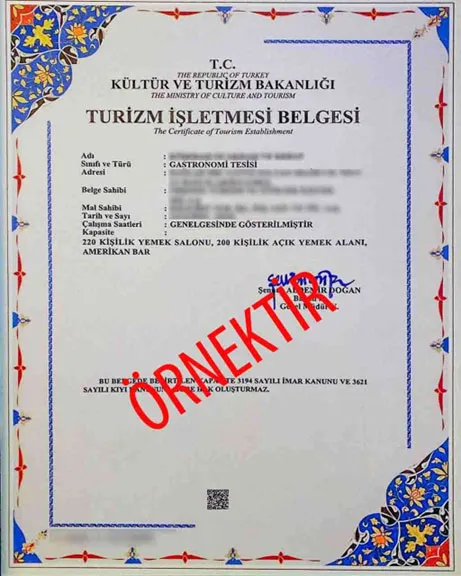
Example of a gastronomy certificate.
Gastronomy establishments possess the following qualities:
– At least one of the following qualifications must be met.
–The business must have brand recognition or reputation in local, regional, national, or international print and visual media in the food and beverage sector, excluding mass production and ready-made meals.
–The business has a right based on a franchise, operating agreement or similar contract which includes the right to use a business that meets the qualifications in subparagraph (1).
– The applicant is a natural person or, if the applicant is a legal entity, the controlling shareholder or another company in which the shareholders own more than fifty-one percent of the shares; having a separate business with the qualifications listed in subparagraph (1) or (2) other than the business for which the document is requested.
– The applicant, whether a natural person or a legal entity, or their controlling shareholder or partners holding a majority of shares, must possess a diploma or internationally recognized certificate in the field of gastronomy from a national or international formal education institution.
– (Addition: RG-4/4/2020-31089-C.K-2360/2 art.) The facility must be located in an area with intense tourism activity.
b) In addition to clause (a), in these facilities:
1) The restaurant must have an à la carte service and meet the specifications stated in subparagraph (f) of the fifth paragraph of Article 14, provided that the kitchen area is at least twenty-five square meters.
2) Businesses with open entrances must have a windbreak, air curtain, revolving door, or similar arrangement at the entrance.
3) The provision of separate toilets and washrooms for male and female customers.
4) The dining hall has an air conditioning system.
5) Furnishings, decorations, equipment, and service materials should be of superior quality or mass-produced, or specially designed and manufactured for the facility by an artist or local producer, or be custom-designed products; and if operating for cuisines of other nations, they should be of high quality and reflect the culture of that country, or incorporate elements of that culture.
6) The head chef must have a diploma from a national or international formal education institution in the field of gastronomy, or an internationally recognized certificate or award, or have local, national or international recognition; if the activity focuses on the cuisine of another nation, a head chef trained in that field must be employed.
7) At least twenty percent of the staff must have received training in their field.
8) The menu must include information on the ingredients, allergenic properties of the products, their suitability for vegetarian or vegan consumption, and whether they contain content sensitive to religious beliefs, all in at least two languages, one of which must be Turkish.
9) If national, regional, or traditional cuisine is served; at least five types of food ingredients must be selected from regional products, cooked using traditional methods or a modern interpretation of traditional methods, and presented, explained, and detailed in the menu.
10) In cases where the activity focuses on the cuisine of another nation, the food ingredients must be prepared and presented using products specific to that cuisine, either in traditional methods or by interpreting traditional methods with modern techniques, and this must be explained and described in the menu.
11) If the business focuses on world cuisine; at least three dishes each from appetizers, intermediate courses, main courses, and desserts must be prepared with high-quality ingredients and presented to the customer with appropriate serving materials, and these must be explained and described in the menu.
12) The food products offered must be prepared by the establishment and meet the required standards.
(3) Documents regarding the preservation of the qualifications in subparagraph (6) of paragraph (b) of the second paragraph are sent to the Ministry every six months.
(4) In establishments located in the immovable cultural heritage requiring protection, the metric measurements of the spaces specified in subparagraph (f) of the fifth paragraph of Article 14 and the service connection between the kitchen and the dining hall are evaluated according to the nature of the building.
HOW TO OBTAIN A GASTRONOMY CERTIFICATE?
Applications are submitted to the Ministry via the e-Government system by completing the application form and facility description form, along with the documents required in the Regulation and Circular. For gastronomy facility tourism business certificate applications, a video file of 5 to 7 minutes in length, including day and night footage of all areas of the facility and its menu, is submitted. For tourism business certificate applications, facilities whose applications are deemed suitable are included in the inspection program after an application review report is prepared.
WHO MAKES UP THE GASTRONOMY CERTIFICATE EVALUATION BOARD?
The Gastronomy Certificate Evaluation Board is chaired by the Deputy Minister of Culture and Tourism, to whom the General Directorate of Investments and Enterprises is subordinate, and consists of the General Director and Deputy General Director of Investments and Enterprises, the Chairman and Deputy Chairman of the Board of Controllers. It decides on requests for the issuance, cancellation, transfer, and addition of an operator's annotation regarding the main activity of tourism certificates for gastronomy establishments.
Following the evaluation board's decision, facilities whose gastronomy certificate applications are deemed suitable are certified. Applicants whose gastronomy certificate applications are deemed unsuitable will be informed in writing, stating the reasons. Facilities with identified deficiencies will be given a period of time to rectify them. If the deficiencies are found to be corrected by the end of this period, the facility will be certified. If the deficiencies are not corrected, the application will be rejected, and the applicant will be informed.
ADVANTAGES OF A GASTRONOMY CERTIFICATE
- With a gastronomy certificate, a license to sell alcoholic beverages openly can be obtained from TABDK (Turkish Alcohol and Tobacco Regulatory Authority).
- The trademark rights are protected by the Ministry of Culture and Tourism.
- Businesses holding a gastronomy certificate are only subject to inspection by the Ministry of Culture and Tourism.
- With a gastronomy certificate, the facility management can adjust operating hours according to the hours set by the Ministry of Culture and Tourism.
- It contributes to the reliability of the facility from the customer's perspective.
DOCUMENTS REQUIRED FOR A GASTRONOMY CERTIFICATE
- Business opening and operating license
- Signature circular, signature declaration,
- Turkish Republic identity number, or if it is a legal entity, trade registry and tax registry numbers,
- Trademark registration certificate,
- Required documents include a copy of the title deed, a lease agreement if the owner is a tenant, the owner's permission for the use of the property for the requested purpose (not required separately if stated in the lease agreement), and the owner's signature declaration or signature circular.
- If it is located within a cultural heritage site requiring protection, a copy of the registration decision or official document is required.
- Periods when the facility is open and closed
WHAT ARE THE REQUIREMENTS FOR A GASTRONOMY CERTIFICATE?
Gastronomy establishments are independent businesses.
- A restaurant located within an accommodation facility cannot apply to the Ministry of Culture and Tourism for a Gastronomy Facility Certificate.
- The food culture in restaurants should be presented to customers as a tourism product.
- All food items served in the restaurant must be prepared by the establishment.
- At least 20% of the staff working in the restaurant must have received training in this area.
- If a restaurant offers a cuisine with traditional, regional, national, or international characteristics, then the food and beverages should be served in accordance with these characteristics.
- The business must be separate from mass production and ready-made meals.
- The restaurant must have brand recognition or a reputation in local, regional, national, or international print and visual media in the food and beverage sector. The establishment must have at least one article or publication in visual or digital media that contains a positive review of its cuisine, menu, service quality, and similar features.
- If the business meeting the criteria is a franchise, it must have the necessary documentation to prove its rights.
- The head chef must possess diplomas or internationally recognized certificates in gastronomy obtained from international educational institutions.
- Businesses with open-air entrances should have windbreaks, air curtains, and revolving doors at the entrance.
- There should be separate toilets and washrooms for male and female customers.
- An à la carte restaurant meeting the requirements of the regulations must have a kitchen area of at least 25 m2.
- The restaurant must have a dining area with a capacity of at least 50 people and a direct connection to the kitchen.
- In restaurants with dining areas up to 200 m², the kitchen must occupy 25% of the dining area, and in those with larger dining areas, it must occupy at least 50 m². This area includes preparation, cooking, dishwashing areas, and other areas performing kitchen functions.
- The furnishings, decorations, equipment, and serving materials must be of superior quality or custom-designed and manufactured for the establishment. If the business caters to cuisines from other nations, they must also reflect the culture of that country in a high-quality and distinctive manner.
- Businesses located within immovable cultural heritage sites requiring protection are evaluated separately according to the nature of the building, considering factors such as metric measurements and service connections between the kitchen and dining area.
- If the main hall and service units are on separate floors, a service staircase or dumbwaiter should be provided.
- The dining hall should have an air conditioning system.
- Product ingredients and allergen characteristics, as well as whether the product is suitable for vegetarian or vegan consumption and whether it contains ingredients with religious sensitivities, must be stated on the menu in at least two languages, one of which must be Turkish.
- If the activity focuses on national, regional, and traditional cuisine, at least five types of food ingredients must be selected from regional products, prepared using traditional methods or a modern interpretation of traditional methods, and the menu must include detailed explanations of the dishes.
- If the activity focuses on the cuisine of another nation, the menu must include information about how the food ingredients are prepared, presented, and described using products specific to that cuisine.
- If the business focuses on world cuisine, it must include at least three dishes each from appetizers, intermediate courses, main courses, and desserts, prepared with high-quality ingredients and presented to the customer with appropriate serving materials, and these should be explained and described in the menu.
WHERE CAN I GET A GASTRONOMY CERTIFICATE?
Gastronomy certificates and tourism business certificates are obtained from the Ministry of Culture and Tourism.
WHERE TO APPLY FOR A GASTRONOMY ESTABLISHMENT CERTIFICATE?
Applications for a gastronomy establishment certificate should be submitted to the General Directorate of Investments and Operations of the Ministry of Culture and Tourism. The relevant authority will evaluate the application, conduct the necessary inspections, and then issue a gastronomy establishment certificate to facilities that meet the required criteria.