What is Chess?
Chess is a strategic mind sport played between two players on an 8×8 board consisting of 64 squares. The main objective is to attack the opponent’s king in such a way that it cannot escape, a situation known as checkmate.
Chess involves very little chance. Success depends mainly on strategy, calculation, concentration, planning, patience, time management, and the ability to anticipate an opponent's moves.
Today, chess is much more than a traditional board game. It is an international mind sport with professional players, coaches, clubs, federations, tournaments, training programs, and championships around the world.
History of Chess
The origins of chess are generally traced back approximately 1,500 years to an ancient Indian strategy game known as Chaturanga. The game later spread to Persia, the Middle East, and Europe.
By around the 15th century, the rules and movement of the pieces in Europe had developed into a form much closer to modern chess.
In 1924,FIDE – the International Chess Federation was founded. Today, FIDE is the principal international governing body for chess and organizes or oversees many major international competitions and world championships.
The Chessboard and Chess Pieces
A chessboard consists of 64 squares:
-
32 light-colored squares
-
32 dark-colored squares
-
8 horizontal ranks
-
8 vertical files
Each player begins the game with 16 pieces:
1 King, 1 Queen, 2 Rooks, 2 Bishops, 2 Knights and 8 Pawns.
There are therefore32 pieces on the board at the beginning of a standard chess game.
When the board is positioned correctly, the square in the bottom-right corner from each player's perspective should be a light-colored square.
How do chess pieces move?
King
The king can move one square in any direction. It is the most important piece because the game ends when a king is checked.
Queen
The queen can move any number of squares horizontally, vertically, or diagonally. It is generally considered the most powerful piece because of its mobility.
Rook
The rook can move any number of squares horizontally or vertically.
Bishop
The bishop moves diagonally. A bishop remains on the same color of square throughout the game.
Knight
The knight moves in anL-shaped pattern: two squares in one direction followed by one square perpendicular to that direction.
The knight is unique because he can jump over other pieces.
Pawn
A pawn normally moves one square forward. From its position, it may move two squares forward.
Unlike its normal movement, a pawn captures an opponent's piece one square diagonally forward.
When a pawn reaches the final rank on the opposite side of the board, it must be promoted to a queen, rook, bishop, or knight.
What Are the Basic Rules of Chess?
White always makes the first move, after which the players alternate turns.
A player cannot make a move that leaves their own king under attack.
When the king is attacked by an opponent's piece, the king is said to be in check.
If the king is in check and there is no legal move that can remove the threat, the position is checkmateAnd the game ends.
Not every chess game ends with checkmate. A game can also finish as a draw under several conditions.
What is Casting?
Castling is a special chess move involving the king and one rook.
There are two forms:
-
Kingside Castle
-
Queenside Castle
Casting is permitted only when certain conditions are satisfied. The king and the relevant rook must not have moved previously, the necessary squares between them must be empty, and the king cannot castle through or into a square where it would be under attack.
Castling is commonly used to improve king safety and activate the rook.
What is En Passant?
En passant is a special pawn capture.
Under specific conditions, when an opposing pawn advances two squares from its original position and finishes beside your pawn, your pawn may capture it as though it had advanced only one square.
This opportunity exists only immediately after the opponent makes the relevant pawn move.
What is Pawn Promotion?
When a pawn reaches the final rank on the opponent's side of the board, it must be promoted.
The player may promote the pawn to a:
A player can therefore have more than one queen or more than the usual number of rooks, bishops, or knights.
What is Checkmate?
The primary objective of chess is to checkmate the opponent's king.
Checkmate occurs when the king is under attack and the defending player cannot legally:
The player who delivers checkmate wins the game.
How Can a Chess Game End in a Draw?
A chess game may end in a draw for several reasons, including:
-
Stalemate
-
Agreement between the players
-
Repetition of the same position under the applicable rules
-
The fifty-move rule
-
A position in which checkmate is impossible
In many tournament scoring systems, a draw gives each player half a point.
What is a Chess Course?
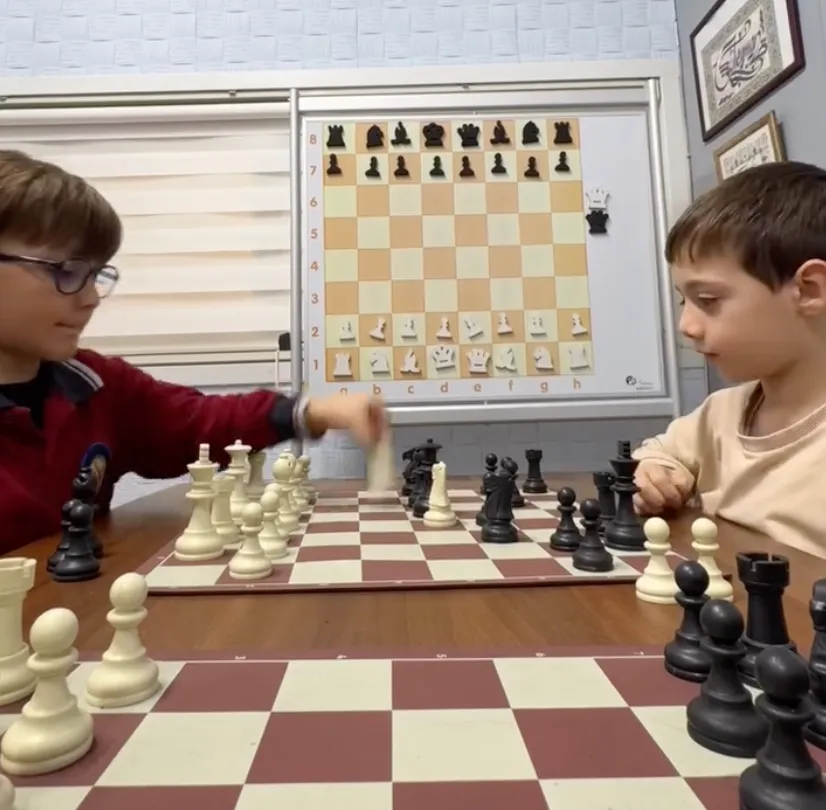
A chess course is a structured training program designed for children, teenagers, or adults who want to learn chess or improve their existing skills.
Chess courses can be organized at different levels, from complete beginner to advanced and competitive tournament training.
Chess education is not limited to learning how the pieces move. A good chess course also teaches players how to analyze positions, identify threats, calculate variations, create plans, and evaluate their own games.
What Do You Learn in a Chess Course?
Beginner-level chess courses commonly cover:
Intermediate courses may include:
-
Opening principles
-
Development of pieces
-
Control of the center
-
King Safety
-
Chess tactics
-
Forks
-
Pins
-
Skewers
-
Double attacks
-
Checkmate patterns
-
Basic endgames
Advanced players may study:
-
Opening theory
-
Positional chess
-
Pawn structures
-
Strategic planning
-
Advanced calculation
-
Endgame theory
-
Game analysis
-
Opponent preparation
-
Tournament strategy
-
Time management
Chess Courses for Children
Chess can be introduced to children through age-appropriate lessons, exercises, puzzles, mini-games, and supervised matches.
Children's chess courses can focus not only on winning games but also on learning how to examine a position before making a move, consider alternatives, recognize patterns, and understand the consequences of decisions.
Training can be organized through schools, chess clubs, sports organizations, private academies, online platforms, or individual coaching.
Benefits of Learning Chess
Chess regularly uses a variety of cognitive and practical skills.
Concentration: Players need to monitor their own plans as well as their opponent's threats.
Problem-solving: Every position presents a different set of challenges.
Planning: Players often need to consider several moves ahead.
Decision-making: A player must choose between multiple possible moves.
Patience: Longer games require careful evaluation rather than rushed decisions.
Pattern recognition: Players gradually learn to recognize tactical patterns, checkmate structures, and common positional ideas.
For these reasons, chess is also widely used as an educational activity.
Who can join a chess course?
Chess courses can be suitable for:
Children, teenagers, adults, beginners, amateur players, club players and competitive tournament players.
Courses can be organized as individual lessons or group classes.
Online chess courses have also made it possible for students to receive training from coaches located in different countries.
What is a Chess Tournament?
A chess tournament is an organized competition in which players compete according to established rules and time controls.
Chess tournaments can use several formats and time controls.
Classical Chess
Players have significantly more thinking time. Classical games can last several hours.
rapid Chess
Rapid chess uses shorter time controls than classical chess.
Blitz Chess
Blitz games are played with very short time limits, requiring players to make decisions quickly.
Competitions may use Swiss-system pairings, round-robin formats, team competitions, knockout formats, or other tournament structures.
What is an Elo Rating?
TheElo rating system is a method used to estimate and compare the competitive strength of chess players.
A player's rating can rise or fall depending on their results against other rated players.
Internationally, FIDE ratings are among the most recognized rating systems in competitive chess.
International Chess Titles
Competitive chess includes several internationally recognized titles.
Some of the best-known are:
There are also titles such as:
TheGrandmaster (GM) title is one of the most prestigious achievements in competitive chess.
Where Is Chess Most Popular Around the World?
Chess is played in almost every country. However, certain countries and regions stand out because of their large chess communities, competitive success, historical traditions, chess education, and tournament activity.
India
India has a special place in chess history because the origins of chess are commonly linked to the Indian game Chaturanga.
Modern India is also one of the world's major chess nations, with a rapidly developing community and many strong young players.
United States
The United States has a large chess community, major tournaments, chess clubs, educational programs, and a strong online chess culture.
Saint Louis has become particularly well known as an important center for elite chess events.
China
China has produced many internationally successful chess players and has been particularly influential in both men's and women's competitive chess.
Russia and the Former Soviet Region
Russia and other countries from the former Soviet chess tradition have played an enormous role in modern chess history.
For decades, many of the world's leading players and world champions came from this region.
Uzbekistan
Uzbekistan has become increasingly prominent in international chess, particularly because of its strong generation of young players.
Azerbaijan
Azerbaijan has a strong chess tradition and has produced numerous internationally recognized grandmasters.
Armenia
Armenia has an exceptionally strong chess culture relative to its population and is well known for its chess education and competitive tradition.
Norway
Norway has gained considerable international chess attention, particularly through the success and global popularity of Magnus Carlsen.
Turkey
Chess is widely played in Turkey, particularly among children and young people.
Chess clubs, schools, private courses, tournaments, and federation activities contribute to the country's growing chess community.
Important Chess Cities Around the World
Several cities are strongly associated with chess because of their tournaments, institutions, history, or player communities.
Saint Louis, USA: Known internationally for major tournaments and chess institutions.
Chennai, India: One of the important centers of India's rapidly growing chess culture.
Moscow, Russia: Historically one of the major cities in international chess.
Baku, Azerbaijan: Known for strong players and major chess competitions.
Tbilisi, Georgia: An important center within the strong chess tradition of the Caucasus.
Tashkent and Samarkand, Uzbekistan: Important locations within Uzbekistan's growing international chess scene.
Budapest, Hungary: A historically important European chess city.
Prague, Czech Republic: A European destination associated with international chess tournaments and events.
Online Chess
The development of the internet has transformed chess into a truly global activity.
Today, players can compete against opponents from almost anywhere in the world within seconds.
Online chess platforms allow players to:
-
Play live games
-
Join tournaments
-
Solve chess puzzles
-
Take chess lessons
-
Analyze games
-
Watch professional competitions
-
Play against international opponents
-
Practice different time controls
Rapid and blitz chess are particularly popular online.
What is a Chess Camp?
A chess camp is an intensive chess training program organized over several days or weeks.
Unlike a standard weekly chess course, camps can combine multiple training sessions with tournaments and recreational activities.
A chess camp may include:
International chess camps can bring together players from different countries, turning chess into both an educational and cultural experience.
Chess Holidays and Chess Tourism
Combining chess with travel creates the concept of a chess holiday or chess tourism.
can visit a destination while receiving chess training, participating in tournaments, meeting participants international players, and enjoying cultural activities.
A chess holiday package could include:
Accommodation + Chess Training + Daily Tournament + City Tours + Cultural Activities + Social Events
Such programs can be organized for children, youth groups, families, amateur players, chess clubs, and adult chess enthusiasts.
How Can an International Chess Camp Be Organized?
An international chess camp can bring together players of different nationalities and skill levels.
A sample five-day program could be:
Day 1: Arrival, registration and player-level assessment
Day 2: Opening training, city tour and rapid chess
Day 3: Tactical training and tournament matches
Day 4: Strategy and endgame training plus cultural activities
Day 5: Tournament finals, awards ceremony and departure
Chess camps can range from three-day weekend programs to seven- or ten-day international chess holidays.
Opening, Middlegame and Endgame
A chess game is commonly divided into three main stages.
Opening
The opening is the beginning of the game.
Players generally aim to develop their pieces, control the center, protect their king, and prepare their position for the middlegame.
Middlegame
The middlegame is where strategic plans, tactical combinations, attacks, defenses, and positional ideas become especially important.
Endgame
The endgame begins when many pieces have been exchanged.
King activity, pawn promotion, calculation, and knowledge of theoretical positions can become extremely important.
A strong chess player should therefore study all three phases of the game.
Chess Strategy vs. Chess Tactics
Chess strategy concerns longer-term plans.
Examples include controlling an open file, attacking a weak pawn, improving the position of a piece, creating a passed pawn, or gaining space.
Chess tactics involve more immediate and concrete combinations.
Common tactical themes include:
-
Forks
-
Pins
-
Skewers
-
Double attacks
-
Discovered attacks
-
Deflections
-
Checkmate combinations
Developing both strategic understanding and tactical calculation is essential for improving at chess.
How to Start Learning Chess
A beginner can follow a simple learning path:
-
Learn how every chess piece moves.
-
Understand check, checkmate, and stalemate.
-
Learn casting, promotion, and passant.
-
Practice basic checkmate positions.
-
Solve beginner chess puzzles.
-
Learn the basic principles of chess openings.
-
Play regularly.
-
Analyze your games.
-
Study games played by stronger players.
-
Join a chess course, chess club, or tournament appropriate to your level.
Regular practice and game analysis are among the most important parts of long-term improvement.
Is Chess Just a Game?
Chess can be considered a game, mind sport, educational activity, competitive discipline, and social experienceat the same time.
For a child, chess can provide a structured environment for learning rules, solving problems, and making decisions.
For an amateur player, it can be an enjoyable lifelong hobby.
For a competitive player, chess can involve years of training, tournaments, international travel, coaching, and professional competition.
Modern technology has also removed many geographical barriers. Players from different countries can now train, compete, and communicate online every day.
Conclusion
Chess is one of the world's oldest and most internationally recognized strategy games and mind sports. Its basic rules can be learned relatively quickly, while its strategic depth can provide a lifetime of learning.
Chess courses help beginners establish strong foundations and allow more experienced players to improve their tactics, strategy, openings, endgames, calculation, and tournament performance.
From children's chess classes and adult training to online lessons, international tournaments, chess camps, and chess holidays, chess offers a wide range of educational, sporting, and recreational opportunities.
Today, chess is much more than two players sitting across a board. It is a global activity connecting education, sport, competition, travel, culture, and international communities.